When a Franna Crane Is the Smarter Choice for Site-to-Site Lifting
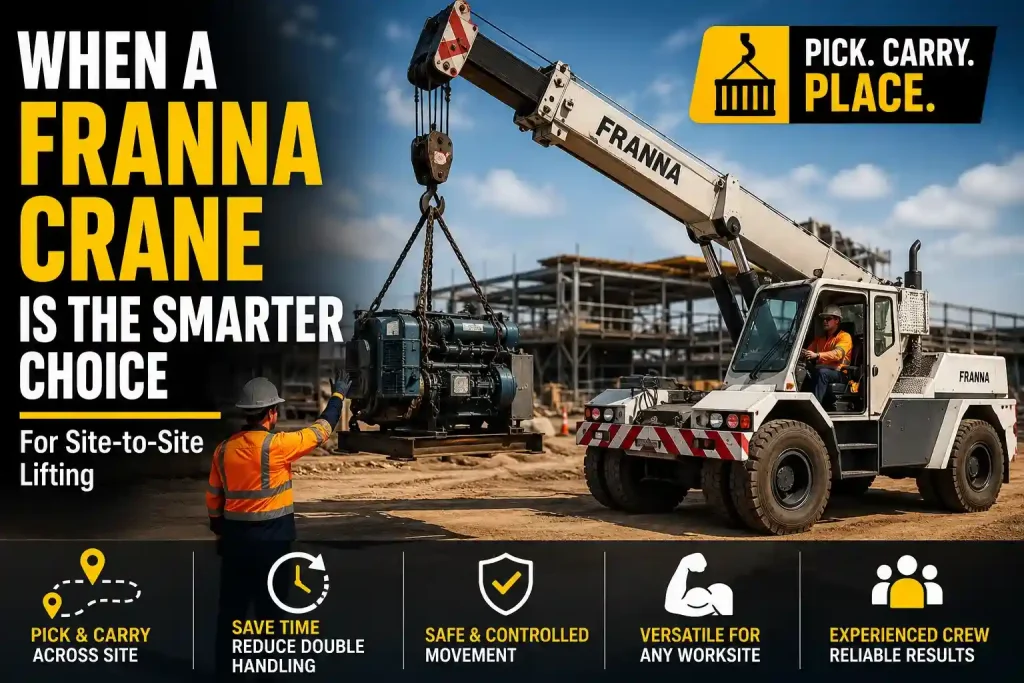
Some lifts are not about height. They are about movement. A load needs to be picked up in one part of a site and placed somewhere else. It may be machinery, steel, building materials, a container, or equipment that cannot be shifted easily by forklift or truck.
That is where Franna crane hire can be the smarter choice. A Franna can pick and carry loads across suitable ground, which makes it useful for worksites where the challenge is not only lifting, but moving the load safely from one area to another.
Frannas Are Built for Practical Movement
A Franna crane works differently from cranes that stay in one setup position. It can lift a load and travel with it under controlled conditions. This makes it useful when teams need to move items across yards, construction sites, industrial areas, or maintenance zones.
The main advantage is simple. The job can often be done with fewer handling steps.
Without a Franna, a team may need to lift the load, place it on transport, move it, unload it, and then reposition it. That may work, but it can also add time, labour, and more chances for something to go wrong.
Frannas can be useful for:
- Moving machinery between work areas
- Relocating heavy site materials
- Supporting plant maintenance
- Shifting loads around industrial yards
- Helping with short-distance equipment moves
- Handling awkward items that need controlled movement
The crane is especially helpful when the load does not need to travel far, but still needs more control than a basic material handling option can provide.
That said, the route matters. A Franna needs a clear, stable path. Ground conditions, slopes, turning areas, nearby workers, and other machinery all need to be checked before the move begins.
The Best Franna Jobs Are Planned Around the Travel Path
With many crane lifts, people focus on the pick-up and drop-off points. With a Franna, the travel path between those points is just as important. The load is moving, so the site needs to be ready for that movement.
Before the job starts, the crew should check the whole path. Is the ground firm? Are there potholes, ramps, trenches, soft patches, or tight corners? Will the crane need to pass near workers, vehicles, stockpiles, or live plant?
A good path check should include:
- Ground stability from start to finish
- Overhead clearance
- Width for safe movement
- Turning room
- Exclusion zones
- Communication with nearby crews
- Weather conditions that may affect ground grip
The load itself also needs attention. Long, wide, or uneven loads may behave differently while travelling. A small movement can feel bigger when the crane is turning or crossing uneven ground.
This is why a Franna job should never feel casual just because the distance is short. Some of the riskiest movements happen when people assume a quick shift does not need much planning.
A well-managed Franna lift feels calm. The route is clear. The crew knows the signals. Other workers know to stay out of the way. The load moves steadily, without last-minute changes.
Where Frannas Can Save Time on Busy Sites
Busy sites often lose time through double handling. A load is placed in one area because the final position is not ready. Later, another crew needs to move it again. Each extra movement uses time, people, and machinery.
A Franna can help reduce that problem when the site layout allows safe pick-and-carry work. It can move materials or equipment closer to where they are actually needed, instead of forcing the team to work around temporary storage points.
This can be useful on:
- Construction sites with changing work zones
- Industrial maintenance projects
- Yard reorganisations
- Machinery relocation jobs
- Infrastructure works
- Short-notice lifting tasks
Frannas are also practical when a project needs flexibility. A fixed-position crane may be right for a larger lift, but it may not be the best fit for moving several items around a site. A Franna can often support those smaller, repeated lifting tasks more efficiently.
Still, the right operator matters. Pick-and-carry work needs judgement. The operator must understand load control, travel speed, site movement, and when to pause if something changes.
The crane may be mobile, but the method still needs discipline.
Conclusion
A Franna crane is often the smarter choice when the job involves moving loads across a site, not just lifting them in one spot. It can reduce double handling, support flexible site movement, and make short-distance heavy lifts easier to manage.
The key is planning the route, not just the lift. With clear access, stable ground, good communication, and an experienced crew, a Franna can become one of the most practical tools on a busy worksite.