Teeth Names: All 32 Adult Teeth Explained [2026]
Adult teeth have four type names: incisors (cutting), canines (tearing), premolars (crushing), and molars (grinding). Adults have 32 teeth total; children have 20 baby teeth. This guide names and explains every one.
Ever stared at a dental chart and wondered what all those teeth names actually mean? You’re not alone. Dentists use specific names for every tooth — incisors, canines, premolars, molars — and knowing them helps you understand everything from teething charts to wisdom-tooth surgery.
This parent-friendly guide covers all 32 adult teeth names and the 20 baby teeth, organized by type and jaw, with plain-English explanations of what each tooth does. Tracking a little one’s milestones? Our baby boy names and baby girl names guides cover the naming side of babyhood.
The 4 Types of Adult Teeth
Every adult mouth contains the same four tooth types. Here’s what each one is called and what it does — the foundation of all teeth names.
| Tooth Type | What It Does | How Many |
|---|---|---|
| Incisors | Thin, sharp teeth for cutting and biting food | 8 total |
| Canines | Pointed teeth for tearing food | 4 total |
| Premolars | Flat-topped teeth for crushing food | 8 total |
| Molars | Large teeth for grinding food | 12 total |
| Wisdom teeth | Third molars; often removed | 4 of the 12 molars |
| Cuspids | Another name for canines | Same 4 teeth |
| Bicuspids | Another name for premolars | Same 8 teeth |
| Eye teeth | Nickname for upper canines | Same 2 teeth |
| Stomach teeth | Old nickname for molars | Same 12 teeth |
| Six-year molars | First permanent molars (age ~6) | 4 teeth |
| Twelve-year molars | Second permanent molars (age ~12) | 4 teeth |
| Deciduous teeth | Scientific term for baby teeth | 20 teeth |
Upper Jaw Teeth Names
The upper arch (maxillary teeth) holds 16 teeth. Dentists number them 1–16 starting from the upper right wisdom tooth.
| Tooth Name | Position | Notes |
|---|---|---|
| Upper central incisors | Front center (2) | The most visible teeth when you smile |
| Upper lateral incisors | Beside the centrals (2) | Slightly smaller than centrals |
| Upper canines | Corner teeth (2) | Also called eye teeth |
| Upper first premolars | Behind canines (2) | Crushing and tearing |
| Upper second premolars | Behind first premolars (2) | Crushing food |
| Upper first molars | Six-year molars (2) | First permanent teeth to arrive |
| Upper second molars | Twelve-year molars (2) | Arrive around age 12 |
| Upper wisdom teeth | Very back (2) | Often extracted |
| Maxillary arch | Whole upper row | Technical term for upper jaw |
| Anterior teeth | Front 6 upper teeth | Incisors + canines |
| Posterior teeth | Back 10 upper teeth | Premolars + molars |
| Palatal surface | Tongue-side of uppers | Anatomy term |
Lower Jaw Teeth Names
The lower arch (mandibular teeth) mirrors the upper with 16 teeth of its own, numbered 17–32 from the lower left wisdom tooth.
| Tooth Name | Position | Notes |
|---|---|---|
| Lower central incisors | Front center (2) | Usually the first baby teeth to erupt |
| Lower lateral incisors | Beside the centrals (2) | Narrower than uppers |
| Lower canines | Corner teeth (2) | Longest roots of front teeth |
| Lower first premolars | Behind canines (2) | Tearing and crushing |
| Lower second premolars | Behind first premolars (2) | Larger chewing surface |
| Lower first molars | Six-year molars (2) | Workhorses of chewing |
| Lower second molars | Twelve-year molars (2) | Arrive around age 12 |
| Lower wisdom teeth | Very back (2) | Most commonly impacted |
| Mandibular arch | Whole lower row | Technical term for lower jaw |
| Anterior teeth | Front 6 lower teeth | Incisors + canines |
| Posterior teeth | Back 10 lower teeth | Premolars + molars |
| Lingual surface | Tongue-side of lowers | Anatomy term |
Baby Teeth Names (Primary Teeth)
Children have 20 primary teeth — 10 up top, 10 on the bottom. They usually arrive between 6 months and 3 years, then fall out to make room for the permanent set.
| Baby Tooth | Count | When It Arrives |
|---|---|---|
| Central incisors | 4 total | 6–12 months |
| Lateral incisors | 4 total | 9–16 months |
| Canines (cuspids) | 4 total | 16–23 months |
| First molars | 4 total | 13–19 months |
| Second molars | 4 total | 23–33 months |
| Upper central incisors | 2 | 8–12 months |
| Lower central incisors | 2 | 6–10 months (usually first) |
| Upper canines | 2 | 16–22 months |
| Lower canines | 2 | 17–23 months |
| Upper second molars | 2 | 25–33 months |
| Lower second molars | 2 | 23–31 months |
| Milk teeth | Nickname for all 20 | Falls out from ~age 6 |
Parts of a Tooth
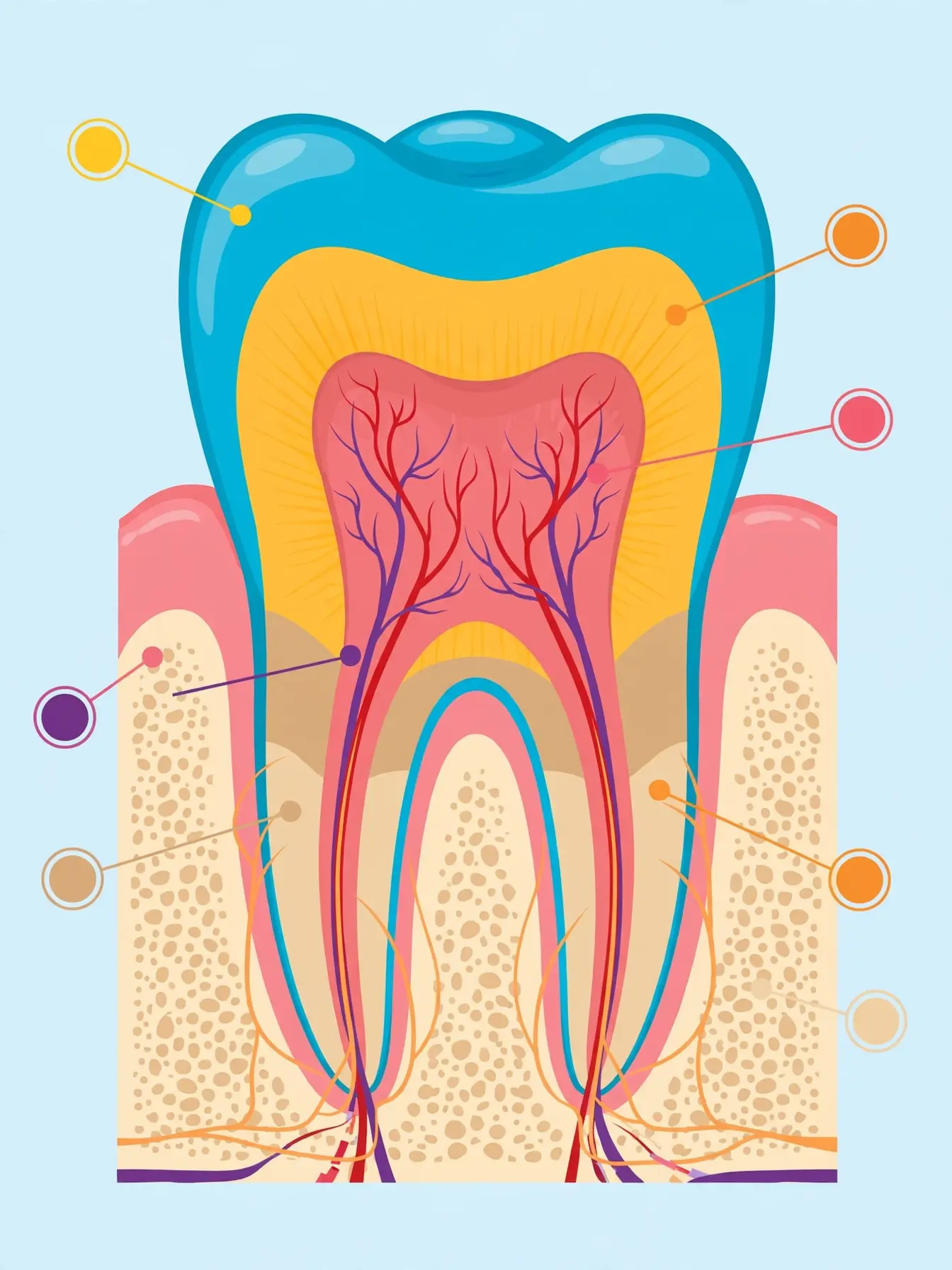
Dentists also name the parts of each individual tooth. Knowing these terms makes dental visits much less mysterious.
| Part | What It Is | Fun Fact |
|---|---|---|
| Crown | Visible part above the gum | Covered in enamel |
| Enamel | Hard outer coating | Hardest substance in the body |
| Dentin | Layer under enamel | Softer than enamel |
| Pulp | Soft center with nerves | Why toothaches hurt |
| Root | Anchors tooth in the jaw | Canines have the longest roots |
| Cementum | Coating on the root | Helps anchor the tooth |
| Gum (gingiva) | Soft tissue around teeth | Protects the roots |
| Cusp | Pointed bump on chewing surface | Molars have 4–5 cusps |
| Fissure | Groove between cusps | Where cavities often start |
| Canine eminence | Bump over upper canines | Gives smiles character |
| Incisal edge | Cutting edge of front teeth | Wears with age |
| Occlusal surface | Chewing surface of back teeth | Where molars grind |
Teething on the brain? Our middle names guide pairs beautifully with any baby-name shortlist, and funny names will keep tired parents laughing through the 2 a.m. wake-ups.
Tips for Learning Teeth Names
- Learn the four types first. Incisors, canines, premolars, molars — everything else is a variation or nickname. Master these and dental charts make sense.
- Use the quadrant trick. Each quarter of your mouth has the same pattern: 2 incisors, 1 canine, 2 premolars, 3 molars. Learn one quadrant, know them all.
- Remember nicknames. “Eye teeth” = upper canines, “wisdom teeth” = third molars, “six-year molars” = first molars. Nicknames are what people actually say.
- Count to 32. 8 incisors + 4 canines + 8 premolars + 12 molars = 32. If your count is off, you’ve missed a wisdom tooth (or had one removed).
- For kids, keep it simple. Little ones only need “front teeth,” “pointy teeth,” and “back teeth” — save the Latin for the dentist.
- Ask your dentist. Next checkup, ask them to point out each tooth type on your own chart — five minutes of show-and-tell beats any diagram.
Frequently Asked Questions
How many teeth do adults have?
Adults typically have 32 teeth: 8 incisors, 4 canines, 8 premolars, and 12 molars (including 4 wisdom teeth). Some adults have fewer if wisdom teeth were removed or never developed.
What are the names of the front teeth?
The four front teeth on top and bottom are called central incisors (middle two) and lateral incisors (next to them). They’re designed for cutting and biting food.
What are canine teeth called?
Canines are also called cuspids, and the upper ones are nicknamed eye teeth. There are 4 total — one in each corner of the mouth — and they’re built for tearing food.
How many baby teeth do children have?
Children have 20 baby (primary) teeth — 10 upper and 10 lower. They begin falling out around age 6 to make room for the 32 permanent teeth.
What are wisdom teeth?
Wisdom teeth are the third molars — the last 4 of the 32 adult teeth, usually arriving between ages 17 and 25. They’re called “wisdom” teeth because they appear when you’re older, and they’re frequently removed due to crowding.
Why do teeth have numbers?
Dentists use the Universal Numbering System (1–32) so every tooth has an exact identity — crucial for records, X-rays, and treatment plans. Tooth #1 is the upper right wisdom tooth; #16 is the upper left wisdom tooth.
Conclusion
From incisors to molars, every tooth has a name and a job. Now that you know all 32 adult teeth names — plus the 20 baby teeth and the parts of each tooth — dental charts will never look like gibberish again.
If this guide helped a parent in the teething trenches, share it — and browse our baby girl names and baby boy names lists for the fun part of babyhood.