Sukuna JJK – Complete Guide to the King of Curses (2025 Updated)
Sukuna JJK Introduction
Ryomen Sukuna stands apart as one of Jujutsu Kaisen’s most iconic antagonists: ancient, arrogant, cunning, and monstrously powerful. To call him merely a “villain” undercuts his narrative weight — Sukuna is both a historical force within the world’s lore and an active, present danger for modern sorcerers. This article unpacks Sukuna from top to bottom: his origin and legend, how he looks and behaves, what makes his cursed techniques terrifying, his decisive fights, and why he remains central to the series’ themes of power, will, and what it means to be human.
Who is Ryomen Sukuna? (Origins & Legend)
According to in-universe history, Sukuna was a fearsome sorcerer born in the Heian Era — a golden age of jujutsu. Over centuries he became mythologized as the “King of Curses,” a name that captures both reverence and terror. Unlike most curses or cursed spirits, Sukuna originated as an overwhelmingly powerful human sorcerer whose soul and cursed energy were so vast that, after death, he persisted by fragmenting into twenty indestructible fingers — cursed objects that retain pieces of his power and will. These fingers become a central plot device: whoever consumes a finger risks Sukuna’s incarnation and the loss of bodily control to the King himself.
Appearance & Visual Traits
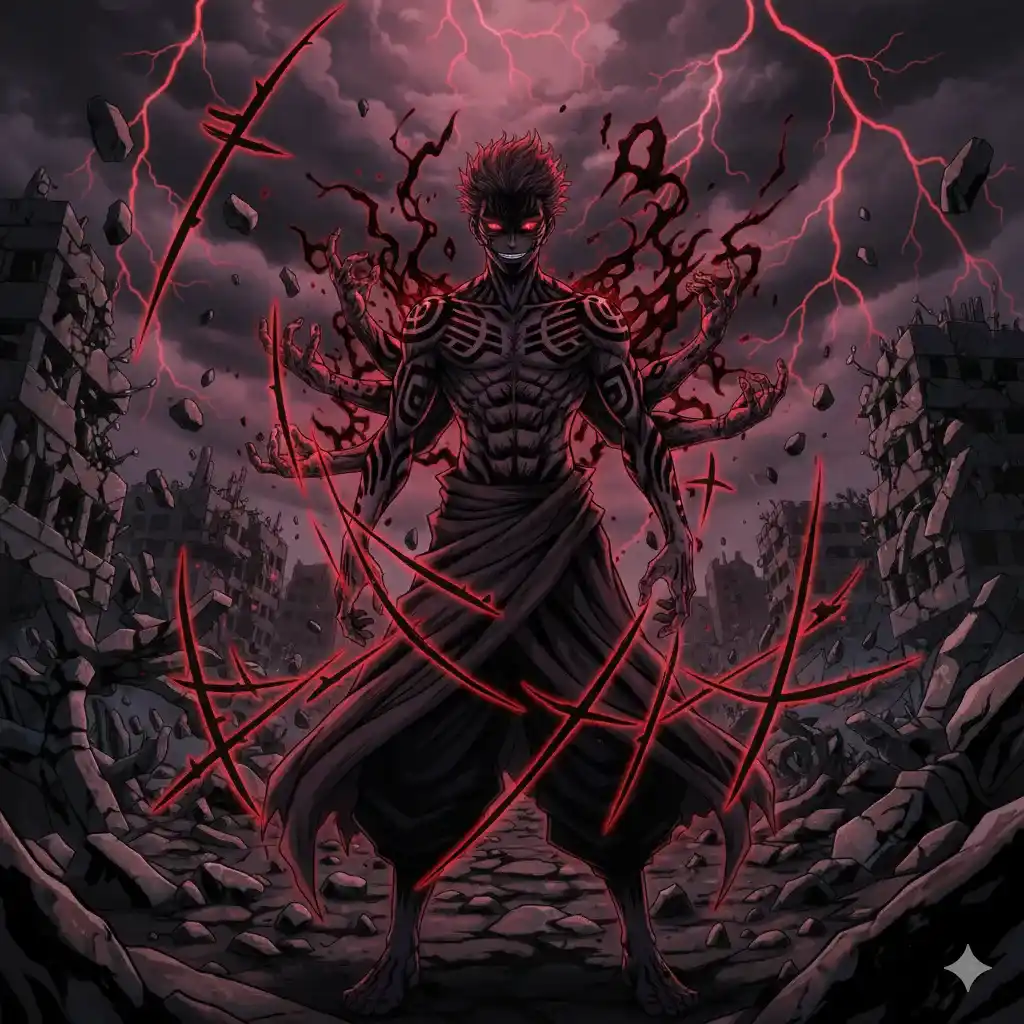
Sukuna’s true form is grotesque and regal at once: a tall, muscular body with four arms, two mouths, and four eyes — a monster in the classic mythic sense. His skin is patterned with black tattoos and circular shoulder marks; the markings also appear on any vessel he possesses. In modern incarnations, Sukuna usually manifests through hosts (notably Yuji Itadori and, later, Megumi Fushiguro), where portions of his true physiology — additional eyes, mouths, and tattoos — appear layered over the host’s features. His design blends classical Japanese aesthetics (kimono and ritualistic motifs) with feral brutality: the perfect visual for a “king” who devours and dominates.
Personality & Motivations
Sukuna’s personality is a study in confident cruelty. He takes pleasure in suffering, exults in combat, and treats human life with contempt. Yet his sadism does not equal stupidity. Sukuna is highly intelligent, strategically patient, manipulative, and capable of complex binding vows and gambits. He is arrogant in the extreme — convinced of his supremacy — yet not blind to tactical realities; he can praise a worthy foe and exploit psychological weaknesses with surgical precision. Beneath the bluster, Sukuna expresses a warped social-Darwinist worldview: might defines worth, and weakness deserves eradication. This philosophy puts him in direct philosophical opposition to protagonists like Yuji, whose attachment to life and empathy undermines Sukuna’s core assumptions.
Core Abilities and Powers
Physical prowess, speed, and reflexes
Sukuna’s raw physical attributes place him among the top echelons of jujutsu combatants. Even fragmented, he demonstrates speed and strength that outclass many special-grade curses and elite sorcerers. He can land blows that rupture buildings, move faster than most can perceive, and parry complex shikigami assaults with brutal efficiency.
Cursed energy and manipulation
Sukuna’s cursed energy reserves are legendary — vast, efficient, and flexible. He can sustain multiple domain activations, amplify hand-to-hand strikes with cursed energy reinforcement, and perform advanced cursed energy feats like complex reverse cursed technique at will. His output rivals and sometimes exceeds other top tier figures in the series.
Innate techniques: Dismantle, Cleave, Divine Flame
Sukuna’s core offensive toolkit centers on slashing techniques that adapt to their targets:
- Dismantle — a ranged slashing attack that can tear through curses and even space-scale phenomena when amplified.
- Cleave — a close-range slashing move that calibrates itself to cut a target based on toughness and cursed energy.
- Divine Flame — destructive flames deployed for long-range attacks and as an amplified domain effect. These flames are extraordinarily powerful, often surpassing other pyrokinetic curses in raw destructive capacity.
Ten Shadows & shikigami mastery (after possessing Megumi)
In a rare twist, when Sukuna inhabited Megumi Fushiguro’s body he gained access to the Zenin-inherited Ten Shadows Technique. Rather than merely copying Megumi’s abilities, Sukuna dominated the technique: he could summon, enhance, and even merge shikigami (Divine Dogs, Nue, Max Elephant, Mahoraga, and others) with his own cursed energy to devastating effect. Taming Mahoraga marks a major milestone — a Ten Shadows first — and reinforces the idea that Sukuna’s mastery extends beyond simple brute force.
Domain mechanics & Malevolent Shrine
Sukuna’s Malevolent Shrine domain is a signature: rather than creating a separate enclosed space, it manifests its effect into the surrounding airspace, relentlessly slicing everything within range with Dismantle and Cleave. It’s brutal, precise, and uniquely configured to bypass ordinary domain protections. Sukuna also uses domain amplification and binding vows to tweak domain performance — for example, shrinking domain range to remove time limits or forming conditional vows to enable enhanced effects like the thermobaric augmentation of Divine Flame inside Malevolent Shrine.
Reverse cursed technique & regeneration
Sukuna’s mastery of reverse cursed technique allows instantaneous regeneration and healing that few can match. He can regrow limbs, sustain a heartless body, and even repair his own soul. These abilities make him exceptionally hard to finish off — even grievous wounds are temporary setbacks when Sukuna can pour in restorative cursed energy.
Timeline & Notable Battles
Sukuna’s contemporary story arc is framed around the finger recoveries and his sporadic but catastrophic activations. Key modern encounters include:
- The early incarnation inside Yuji Itadori, where Sukuna forced binding vows and toyed with Yuji’s agency.
- Battles against top curses and sorcerers during events like Shibuya and Shinjuku, where his power surge was felt citywide.
- The startling moment when Sukuna seized Megumi’s body, showcasing both his tactical cunning and new access to the Ten Shadows arsenal.
- The climactic confrontation with Satoru Gojo, a clash representing not just raw power but ideological stakes for the jujutsu world.
Each confrontation reveals layers of Sukuna’s capability: surgical intelligence, adaptive technique learning, and the willingness to use binding vows and sacrifice to achieve decisive outcomes.
Sukuna’s Relationship with Yuji Itadori & Megumi Fushiguro
Sukuna’s dynamic with Yuji is central and paradoxical. Yuji is Sukuna’s vessel and his polar opposite: compassionate, human, and protective. Sukuna both derides Yuji’s empathy and shows fixation on him because Yuji’s stubborn will challenges Sukuna’s worldview. With Megumi, Sukuna exhibits a different interest: curiosity and strategic valuation. He recognizes Megumi’s potential and, at times, behaves almost possessively — not out of friendship, but because Megumi represents a rare and useful talent. These relationships drive narrative tension: Sukuna’s presence forces Yuji and Megumi to confront power, identity, and moral choices under extreme pressure.
Tactical Profile: How Sukuna thinks in combat
Sukuna blends raw supremacy with surgical intellect. He:
- Observes and deduces quickly after seeing a technique once or twice.
- Uses binding vows to reconfigure limitations into tactical advantages.
- Prefers to manipulate psychological context — taunting, deceiving, and exploiting mercy or pity.
- Balances brutal frontal offense and subtle long-term stratagem, making him unpredictable: he can choose to humiliate an opponent or end them swiftly if the political or personal stakes demand it.
Story Impact & Thematic Role in JJK
Sukuna is more than an obstacle; he is a thematic fulcrum. He represents unrestrained power, the corrosive logic of social Darwinism, and the moral test for protagonists. Through Sukuna, the series explores what it means to wield power responsibly versus reveling in domination. His presence exacerbates existing conflicts while forcing characters to evolve: alliances form, vows are made, and world-shaping decisions hinge on containing or confronting Sukuna.
Fan Theories & Speculation
Popular theories include:
- Sukuna’s true endgame involves reconstituting a full human body and reshaping the jujutsu world under his rule.
- His selective mercy — praising foes — is a chess move to create stronger opponents and thus a more meaningful field of conquest.
- Connections to ancient myths (Ryōmen Sukuna in classical Japanese texts) hint at hidden lore and potential vulnerabilities rooted in ritual or historical artifacts.
These theories reflect how fans read Sukuna as both a personal antagonist and a narrative engine.
Quick Reference Table — Sukuna at a Glance
| Attribute | Detail |
|---|---|
| Title | Ryomen Sukuna — “King of Curses” |
| Origin Era | Heian Era (legendary) |
| True Form | Four arms, two mouths, four eyes, tattooed body |
| Modern Vessels | Yuji Itadori; later Megumi Fushiguro (partial possession) |
| Signature Techniques | Dismantle, Cleave, Divine Flame, Malevolent Shrine |
| Unique Traits | Ten Shadows mastery (while in Megumi), reverse cursed technique |
| Domain Type | Malevolent Shrine — manifested domain with slashing guaranteed hits |
| Tactical Style | Sadistic, surgical, manipulative, adaptive |
| Notable Fights | Jogo, Mahoraga, Gojo (climactic), various Shibuya/Shinjuku events |
FAQs
How old is Sukuna?
Sukuna lived and fought in the Heian Era, making him over a thousand years old as a cursed, fragmented presence in modern times.
What is Sukuna’s true form?
His true, original body is a four-armed, two-faced, tattooed sorcerer. When possessing modern vessels he manifests secondary eyes/mouths and tattoos.
Can Sukuna be killed?
Sukuna’s regenerative capacity and fragmented soul complicate straightforward death. Complete eradication would likely require eliminating every finger and disrupting his soul’s binding — a monumental narrative obstacle.
Why does Sukuna like Megumi?
Sukuna values strength and potential; Megumi’s unique Ten Shadows inheritances and tactical capacity intrigue Sukuna, who sees utility and a rare spark of promise.
What is Malevolent Shrine?
Sukuna’s domain expansion that manifests slashing attacks into surrounding airspace, inflicting guaranteed cuts across its radius without forming an enclosed “space” like most domains.
Conclusion
Ryomen Sukuna operates on multiple narrative axes: historical calamity, personal antagonist, philosophical counterpoint, and engine of escalation. He is terrifying because of what he does and chilling because of how he thinks. Understanding Sukuna requires looking past spectacle to see the jujutsu logic he exploits: cursed energy as both weapon and worldview, binding vows as contractual power, and violence used not merely as force but as an aesthetic of dominance. For fans, writers, and theorists, Sukuna is an inexhaustible subject: a character who forces the series’ protagonists — and the readers — to ask what they value and how far they’ll go to protect it.