47 Spanish Last Names with Meanings & Origins
Spanish surnames are among the most widespread family names on the planet — carried by hundreds of millions of people across Spain, Latin America, and the United States. Each one tells a story: a father’s name frozen in time, a medieval occupation, a village left behind centuries ago. This guide focuses purely on Spanish surnames — if you’re after given names instead, see our Spanish first names list, or browse the broader last names collection for surnames from every culture.
Whether you’re tracing your family tree, naming a character in a novel, or researching names for a baby, knowing what a surname actually means adds depth a bare list can’t. Every entry below comes from established surname etymology — and where scholars genuinely disagree, as with García, we say so instead of guessing.
Most Common Spanish Last Names
These are the surnames you’ll encounter everywhere Spanish is spoken — on class rosters in Madrid, in phone books in Mexico City, and on birth records in Los Angeles. Notice the pattern: nearly all end in -ez, the classic Spanish patronymic suffix meaning “son of.” Rodríguez is literally “son of Rodrigo” — a naming habit that turned fathers’ first names into permanent family names. For perspective on how these stack up globally, see our common last names list.

| Last Name | Meaning | Origin/Notes |
|---|---|---|
| García | Uncertain — possibly Basque; “bear” commonly cited but debated | Spanish |
| Fernández | Son of Fernando | Spanish (patronymic) |
| González | Son of Gonzalo | Spanish (patronymic) |
| Rodríguez | Son of Rodrigo | Spanish (patronymic) |
| López | Son of Lope (from Latin lupus, “wolf”) | Spanish (patronymic) |
| Martínez | Son of Martín (Latin, “of Mars”) | Spanish (patronymic) |
| Sánchez | Son of Sancho | Spanish (patronymic) |
| Pérez | Son of Pedro (Greek, “stone”) | Spanish (patronymic) |
| Gómez | Son of Gome (Germanic, “man”) | Spanish (patronymic) |
| Hernández | Son of Hernando (variant of Fernando) | Spanish (patronymic) |
| Díaz | Son of Diego | Spanish (patronymic) |
| Ruiz | Son of Ruy (short form of Rodrigo) | Spanish (patronymic) |
Patronymic Spanish Surnames
Beyond the famous dozen above, the patronymic tradition produced dozens more Spanish surnames — each one a medieval father’s name with -ez, -az, or -iz attached. These work exactly like Johnson (“son of John”) or MacDonald (“son of Donald”) in English and Scottish naming. Here are four more well-established examples.
| Last Name | Meaning | Origin/Notes |
|---|---|---|
| Jiménez | Son of Jimeno | Spanish (patronymic) |
| Álvarez | Son of Álvaro (Germanic, “all-guard”) | Spanish (patronymic) |
| Domínguez | Son of Domingo (Latin, “of the Lord”) | Spanish (patronymic) |
| Vázquez | Son of Vasco (Basque, “Basque”) | Spanish (patronymic) |
Occupational & Descriptive Spanish Surnames
Not every Spanish surname honors a father. Medieval Spaniards were just as often named for what they did, what they looked like, or who they were — the blacksmith became Herrera, the thin man became Delgado, the warrior became Guerrero. These descriptive surnames are favorites for character naming because their meanings are instantly evocative.
| Last Name | Meaning | Origin/Notes |
|---|---|---|
| Moreno | Dark-haired or dark-skinned | Spanish (descriptive) |
| Blanco | White or fair-haired | Spanish (descriptive) |
| Delgado | Thin, slender | Spanish (descriptive) |
| Guerrero | Warrior | Spanish (occupational) |
| Serrano | Mountain dweller (from sierra) | Spanish (topographic) |
| Ramos | Branches (Palm Sunday branches) | Spanish (descriptive) |
| Herrera | Ironworks, blacksmith | Spanish (occupational) |
| Molina | Mill | Spanish (occupational) |
| Cabrera | Goat herd (from cabra, “goat”) | Spanish (occupational) |
| Romero | Pilgrim (to Rome) | Spanish (descriptive) |
Geographic & Place-Based Spanish Surnames
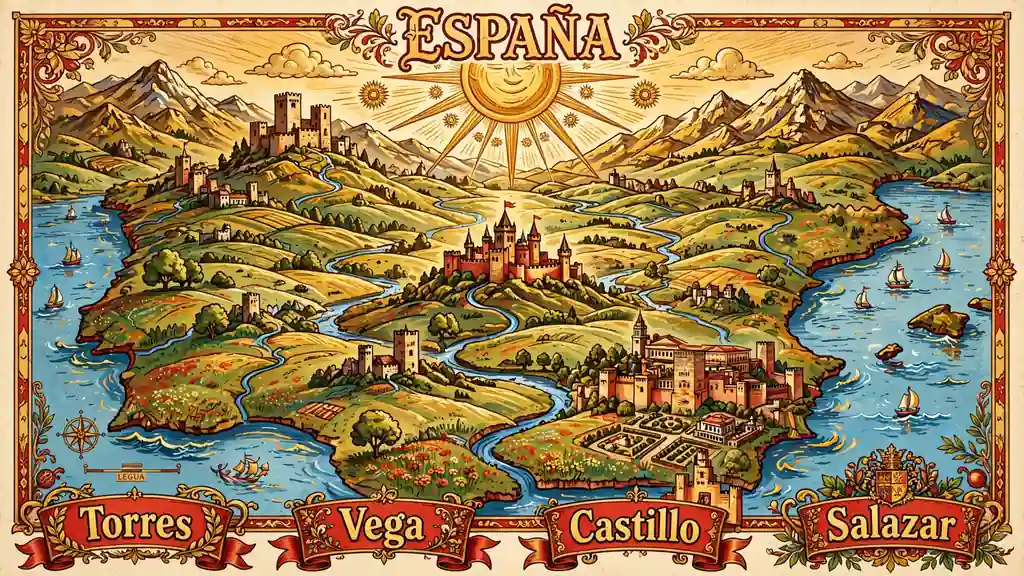
Place-based surnames mark where a family came from or what the landscape looked like around their home — a castle, a river, a meadow, a rocky cliff. Many of Spain’s oldest noble houses took their names this way: the Mendoza, Salazar, and Aguilar families all bear the names of places they once held. Romance-language neighbors developed the same habit, as you’ll see in our Italian last names and French last names guides.
| Last Name | Meaning | Origin/Notes |
|---|---|---|
| Torres | Towers — one who lived by towers | Spanish (topographic) |
| Castillo | Castle — one who lived near a castle | Spanish (topographic) |
| Navarro | From Navarre | Spanish (regional) |
| Ortega | Nettle patch (from ortiga) | Spanish (topographic) |
| Vega | Meadow, fertile plain | Spanish (topographic) |
| Aguilar | Eagle’s nest (from águila, “eagle”) | Spanish (topographic) |
| Mendoza | Cold mountain (Basque mendi + otz) | Spanish (Basque) |
| Fuentes | Fountains, springs | Spanish (topographic) |
| Iglesias | Churches — one who lived near churches | Spanish (topographic) |
| Mora | Blackberry (place name) | Spanish (topographic) |
| Peña | Rock, cliff | Spanish (topographic) |
| Soto | Grove, thicket | Spanish (topographic) |
| Campos | Fields | Spanish (topographic) |
| Ríos | Rivers | Spanish (topographic) |
| Salazar | Old hall (Basque sala + zahar) | Spanish (Basque) |
| Luna | Moon (also a place name) | Spanish |
| Flores | Flowers | Spanish |
| Rosa | Rose | Spanish |
Spanish Surnames with Uncertain Origins
Honest etymology means admitting what we don’t know. These famous Spanish surnames have been debated by scholars for generations, with competing theories and no consensus — so they’re marked “Uncertain” rather than dressed up with a favorite story.
| Last Name | Meaning | Origin/Notes |
|---|---|---|
| Guzmán | Uncertain — possibly Germanic | Spanish |
| Vargas | Uncertain | Spanish |
| Contreras | Uncertain | Spanish |
The Spanish Two-Surname Tradition
One of the most distinctive features of Spanish naming is that most people carry two surnames, not one. Traditionally, the first comes from the father (apellido paterno) and the second from the mother (apellido materno) — so the child of Eduardo Fernández Garrido and María Martínez Ruiz would most commonly be known as José Fernández Martínez. Women in Spain generally keep their own surnames after marriage rather than adopting a husband’s name. The tradition spread across the Spanish-speaking world, which is why you’ll find the same double-surname pattern in our Mexican last names guide. You can read the full breakdown on Wikipedia’s Spanish naming customs page.
How to Use Spanish Surnames
A surname’s meaning matters most when you put it to work. Here’s how to get the most from this list:
- For genealogy: Start with the meaning, then the place. A geographic surname like Navarro or Vega points to a region; a patronymic like Domínguez points to an ancestor named Domingo. Verify spellings against real records — accents and -ez/-es variants shift across borders.
- For character naming: Match the surname’s meaning to the character’s role or arc — Guerrero for a fighter, Vega for someone tied to the land, Serrano for a mountain-born outsider. Pair with given names from our boy names list and say the full name aloud.
- For baby naming: Spanish surnames occasionally cross over as distinctive middle or first names (Cruz and Vega both work this way). Check the meaning first — you want Luna’s “moon,” not an accidental insult.
- Verify before you commit: Etymology sites like Behind the Name’s surname section let you double-check any surname’s origin before it goes on a birth certificate or a book cover.
- Respect the double surname: If you’re writing a character from a Spanish-speaking background, remember they likely carry two surnames — getting this detail right adds instant authenticity.
Frequently Asked Questions
Why do Spanish people have two last names?
Spanish naming tradition gives each person two surnames: the first from the father (apellido paterno) and the second from the mother (apellido materno). This preserves both family lines in every generation, so a child carries a piece of each parent’s heritage rather than losing the maternal line at marriage.
What does the -ez ending in Spanish last names mean?
The -ez suffix means “son of” — it’s a patronymic marker. Fernández means “son of Fernando,” Rodríguez means “son of Rodrigo,” and López means “son of Lope.” The pattern dates to medieval Spain, when a father’s given name plus -ez became his children’s permanent family name.
What is the most common Spanish last name?
García is widely considered the most common surname in Spain, consistently topping official surname rankings, with Fernández and González close behind. All three are also extremely common throughout Latin America and among Hispanic communities in the United States.
Is García a Basque name?
Possibly, but scholars disagree. García is often described as Basque in origin — “bear” is the meaning most commonly cited — but the etymology is genuinely debated and no theory has won consensus. It’s marked “Uncertain” in the table above rather than presenting any single theory as fact.
Do Spanish women change their last name when they marry?
Traditionally, no. In Spain, women keep their birth surnames after marriage — there is no custom of adopting a husband’s family name. Children then receive one surname from each parent, so both family lines continue.
Can I use a Spanish last name as a first name for my baby?
Yes — several Spanish surnames work beautifully as given names. Cruz, Vega, and Luna are all established crossover picks. Just check the surname’s meaning first and say the full name aloud to make sure it flows with your family’s other names.
Conclusion
Spanish last names are miniature history lessons — a father’s name, a medieval trade, a village, a mountain, a river. The 47 surnames above cover the full range: patronymics like Fernández and Rodríguez, descriptive names like Moreno and Delgado, place names like Vega and Salazar, and a few famous mysteries like García and Guzmán. Whether you’re tracing ancestors, naming a character, or choosing a name for your baby, start with the meaning — it’s the part of the name that lasts. For more surname inspiration, explore our full last names collection.