50+ Greek Last Names: Meanings & Origins
The most common Greek last names include Papadopoulos, Georgiou, Papas, and Papadakis. Greek surnames are famously built from a father’s first name plus an ending that means “son of” — so Papadopoulos means “son of a priest.” Below you’ll find 50+ Greek last names with meanings and origins, organized so you can decode any Greek surname you meet.
Greek surnames are wonderfully logical once you learn the code. See -opoulos at the end? That means “son of.” Spot -akis? You’re probably looking at a Cretan family. Notice Papa- at the start? An ancestor was likely a priest. In a few minutes, you’ll be reading Greek last names like a genealogist.
Greece’s surname tradition stretches back centuries, shaped by the Orthodox Church, Ottoman-era history, and strong regional identities — from Crete to the Pontic mountains to Cyprus. Millions of people of Greek descent live in the United States, Australia, and Canada, so these surnames are familiar far beyond Greece itself. Whether you’re tracing your Greek roots or naming a character, this guide gives you 50+ Greek last names with real meanings and origins.
Most Common Greek Last Names
These are the surnames you’ll encounter most often in Greece and in Greek communities abroad. Notice how many begin with Papa- — a legacy of how many families descend from, or were named for, village priests.
| Last Name | Meaning | Origin |
|---|---|---|
| Papadopoulos | Son of a priest | Papa- (priest) + -opoulos (son of) |
| Papas | Priest | Direct occupational name |
| Papadakis | Little priest | Cretan diminutive of Papas |
| Georgiou | Son of Georgios (farmer) | Genitive patronymic; Cyprus and mainland |
| Demetriou | Son of Demetrios | Genitive patronymic |
| Nikolaou | Son of Nikolaos (victory of the people) | Genitive patronymic |
| Ioannou | Son of Ioannis (John) | Genitive patronymic |
| Konstantinou | Son of Konstantinos | Genitive patronymic |
| Petrou | Son of Petros (rock, Peter) | Genitive patronymic |
| Andreou | Son of Andreas (manly) | Genitive patronymic |
| Athanasiou | Son of Athanasios (immortal) | Genitive patronymic |
| Christopoulos | Son of Christos | -opoulos patronymic |
| Papanikolaou | Son of Papa-Nikolaos (a priest named Nicholas) | Compound priestly patronymic |
| Papadaki | Little priest (feminine form) | Cretan diminutive, feminine |
Greek Patronymic Surnames (“Son Of”)
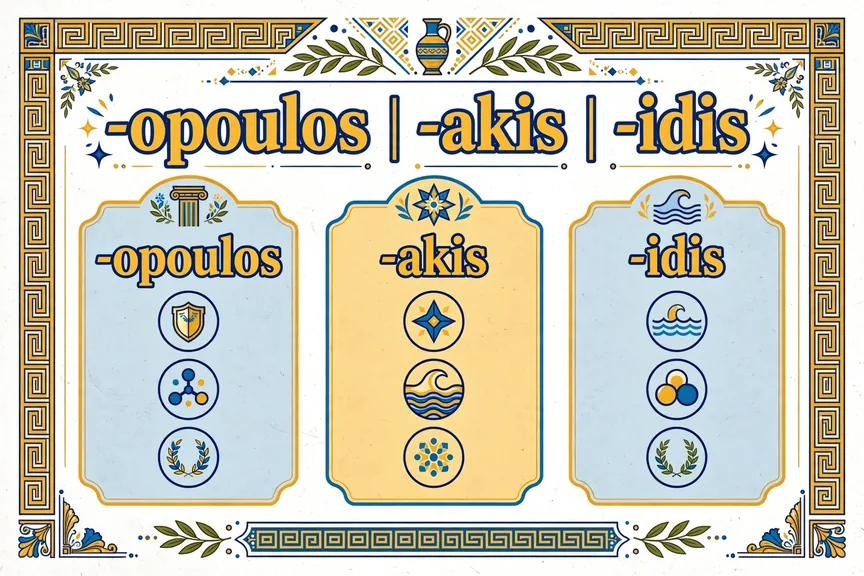
The great majority of Greek surnames are patronymics — “son of [father’s name].” The ending tells you the region: -opoulos is Peloponnesian, -idis/-ides is Pontic (Black Sea Greeks), -oglou comes from Asia Minor Greeks, and -akis is Cretan.
| Last Name | Meaning | Origin |
|---|---|---|
| Theodoropoulos | Son of Theodoros (gift of God) | Peloponnesian -opoulos |
| Angelopoulos | Son of Angelos (messenger) | Peloponnesian -opoulos |
| Stavropoulos | Son of Stavros (cross) | Peloponnesian -opoulos |
| Markopoulos | Son of Markos | Peloponnesian -opoulos |
| Vasilakis | Little Vasilis (kingly) | Cretan -akis diminutive |
| Petrakis | Little Petros (rock) | Cretan -akis diminutive |
| Manolakis | Little Manolis (Emmanuel) | Cretan -akis diminutive |
| Karamanlis | Uncertain — possibly from Karaman (Asia Minor region) | Asia Minor Greek |
| Eleftheriou | Son of Eleftherios (free) | Genitive patronymic |
| Vasiliou | Son of Vasilis (kingly) | Genitive patronymic |
| Georgopoulos | Son of Georgios (farmer) | Peloponnesian -opoulos |
| Nikolopoulos | Son of Nikolaos (victory of the people) | Peloponnesian -opoulos |
Occupational & Descriptive Surnames
Not every Greek surname comes from a father’s name. Many describe what an ancestor did — or what he looked like. Psaras means “fisherman,” Mavros means “dark” (dark-haired or dark-skinned), and Kontos means “short.”
| Last Name | Meaning | Origin |
|---|---|---|
| Psaras | Fisherman | Occupational |
| Economou | Steward, manager | Occupational (oikonomos) |
| Vlahos | Vlach (shepherd people) | Ethnic/occupational |
| Mavros | Dark, black | Descriptive (hair or complexion) |
| Aspros | White | Descriptive |
| Kontos | Short | Descriptive (stature) |
| Makris | Long, tall | Descriptive (stature) |
| Katsaros | Curly-haired | Descriptive |
| Hadjipetrou | Son of Hadji-Petros (a pilgrim named Petros) | Hadji = one who made a pilgrimage |
| Papageorgiou | Son of Papa-Georgios (a priest named George) | Compound priestly patronymic |
| Raptis | Tailor | Occupational |
| Sideris | Ironsmith | Occupational |
Regional Surnames: Crete, Pontus & Cyprus
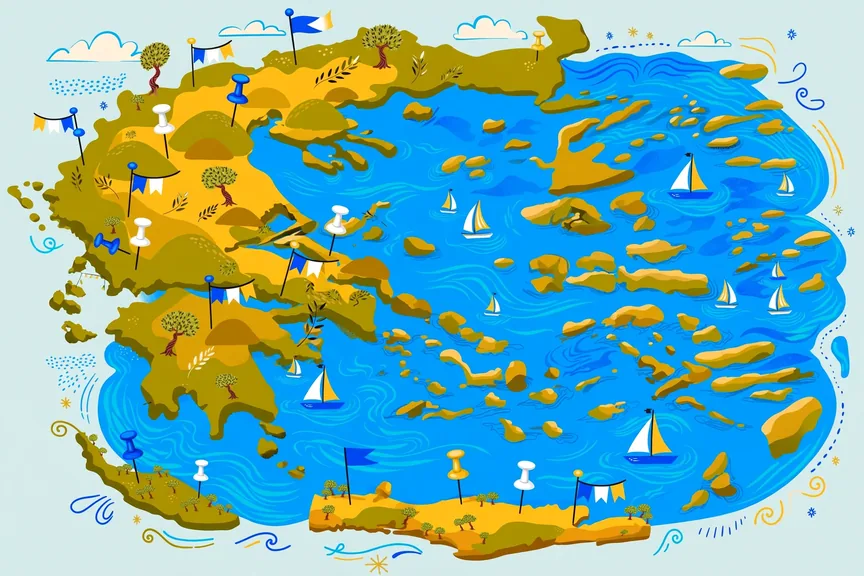
Greek surnames are regional passports. Crete loves -akis; the Pontic Greeks of the Black Sea coast used -idis; Cyprus favors genitive forms like -ou; and Asia Minor refugee families brought -oglou names after 1922.
| Last Name | Meaning | Origin |
|---|---|---|
| Kazantzakis | Uncertain — Cretan family name | Crete (-akis) |
| Xylouris | Uncertain — Cretan family name | Crete |
| Mikroutsikos | Uncertain — Asia Minor Greek | Asia Minor (-oglou pattern region) |
| Karagiannis | Black Giannis (John) | Descriptive + name compound |
| Papandreou | Son of Papa-Andreas (a priest named Andrew) | Compound priestly patronymic |
| Samaras | Saddlemaker | Occupational |
| Tsipras | Uncertain — possibly from a nickname | Regional |
| Mitsotakis | Little Mitsos (diminutive of Dimitris) | Cretan -akis |
| Karamalis | Uncertain — possibly “black honey” or a nickname | Regional |
| Venizelos | Uncertain — famous Cretan family name | Crete |
| Kritikos | Cretan (person from Crete) | Place-based; found across Greece |
| Maniatis | Person from Mani (Peloponnese) | Place-based |
Decoding Greek Name Endings
Here’s your cheat sheet. -opoulos = “son of” (Peloponnese). -idis / -ides = “son of” (Pontic/Asia Minor). -oglou = “son of” (Turkish-derived, Asia Minor). -akis = “little” (Crete). -ou (Georgiou, Papadopoulou) = genitive “of,” used in Cyprus and for women’s surnames. Papa- at the start almost always signals a priest ancestor. With these six patterns, you can decode the majority of Greek surnames on sight. For the biggest surnames ranked, see our most common last names; for rare finds, browse unique last names.
Greek first names follow the same ancient roots — explore our Greek names with meanings guide, our Italian last names for a Mediterranean parallel, or browse last names from around the world for more surname traditions.
Frequently Asked Questions
What does -opoulos mean in Greek last names?
-opoulos means “son of” or “descendant of.” Papadopoulos = “son of a priest,” Theodoropoulos = “son of Theodoros.” It is the most characteristically Peloponnesian surname ending in Greece, and families carrying it can often trace their roots to the Peloponnese region specifically.
Why do Greek women’s last names end differently?
Traditionally, a Greek woman’s surname is the genitive (possessive) form of the family’s name — Papadopoulos becomes Papadopoulou (“of Papadopoulos”). In modern practice, many women keep the masculine form, especially abroad. In official Greek documents, however, the feminine genitive form is still the norm.
What is the most common Greek surname?
Papadopoulos is generally cited as the most common surname in Greece, followed by names like Papanikolaou, Papadakis, and Georgiou. Exact rankings vary by source and year.
Do Greek last names show where a family is from?
Often, yes. The ending is the biggest clue: -akis suggests Crete, -idis suggests Pontic (Black Sea) roots, -oglou suggests Asia Minor, and -opoulos is strongly Peloponnesian. Combined with the root name, you can often place a family within a region.
What does Papadakis mean?
Papadakis means “little priest” — it’s the Cretan diminutive form of Papas (priest). It’s one of the most common surnames on Crete.
Conclusion
From Papadopoulos (“son of a priest”) to Psaras (“fisherman”) to Mavros (“dark”), Greek last names are miniature family histories — each ending a clue, each root a story. Once you know the patterns, every Greek surname starts talking. Naming a baby too? Explore our baby boy names or discover more in our Greek names collection.