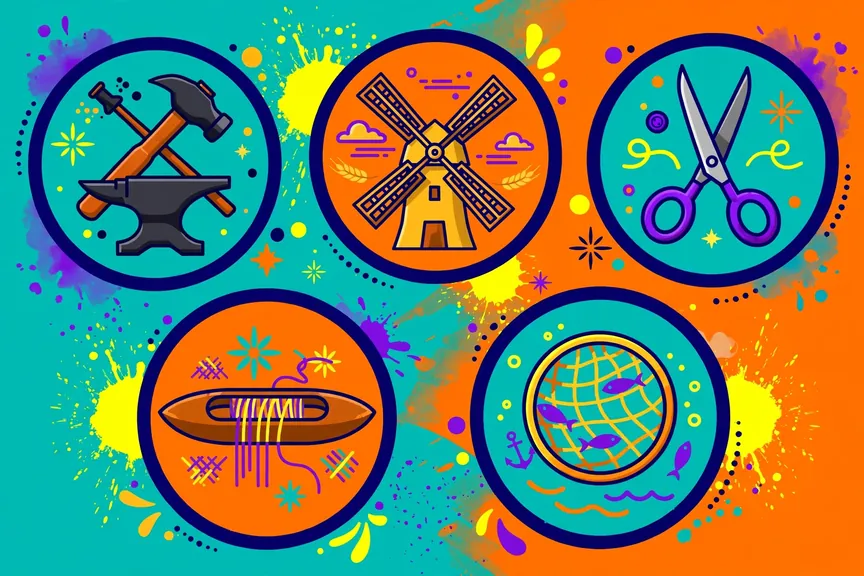
The most common German last names are Müller, Schmidt, Schneider, Fischer, and Weber — and their meanings are delightfully literal: Müller means “miller,” Schmidt means “smith,” and Schneider means “tailor.” German surnames grew out of medieval jobs, nicknames, and hometowns, so most of them tell you exactly what an ancestor did for a living. Below you’ll find 50+ German surnames with meanings and origins, organized by type.
German last names are some of the most transparent in the world. While many English surnames have drifted away from their original meanings, a German speaker hears Schmidt and immediately thinks “blacksmith” — no dictionary required. That clarity makes German surnames a goldmine for genealogy research, historical fiction, and anyone curious about their family roots.
Most German family names became hereditary between the 12th and 16th centuries, when growing towns needed a way to tell the many Hanses and Peters apart. The solution was practical: add the man’s trade (Schmidt, the smith), his father’s name (Peters, son of Peter), a nickname (Klein, the small one), or his hometown (Franke, from Franconia). Once fixed, these names stuck — and today they rank among the most common surnames in Germany, Austria, and Switzerland.
Most Common German Last Names
These twelve surnames appear at the top of virtually every German name ranking. Notice the pattern: nearly all of them are job titles. Medieval Germany was a land of guilds and workshops, and the smith, the miller, and the tailor were fixtures of every town. For the global picture, see our main last names guide and our list of common last names across cultures.
| Last Name | Meaning | Origin / Type |
|---|---|---|
| Schmidt | Smith (metalworker) | Occupational |
| Müller | Miller | Occupational |
| Schneider | Tailor | Occupational |
| Fischer | Fisher, fisherman | Occupational |
| Weber | Weaver | Occupational |
| Meyer | Estate manager, high-ranking tenant farmer | Occupational / status |
| Wagner | Wagon maker, cartwright | Occupational |
| Becker | Baker (Low German form) | Occupational |
| Schulz | Village headman, constable | Occupational / status |
| Hoffmann | Steward, man of the court | Occupational |
| Schäfer | Shepherd | Occupational |
| Koch | Cook | Occupational |
German Occupational Surnames
Occupational surnames are by far the largest category of German family names. If your ancestors lived in a German-speaking region, chances are their surname describes exactly what they did all day. Beyond the top twelve, here are more craft and trade surnames you will encounter constantly in German family trees.
| Last Name | Meaning | Origin / Type |
|---|---|---|
| Zimmermann | Carpenter (literally “room man”) | Occupational |
| Maurer | Mason, bricklayer | Occupational |
| Metzger | Butcher | Occupational |
| Bauer | Farmer, peasant | Occupational |
| Schröder | Tailor, cloth-cutter | Occupational |
| Kramer | Shopkeeper, small merchant | Occupational |
| Schmied | Smith (variant of Schmidt) | Occupational |
| Gerber | Tanner (leather worker) | Occupational |
| Töpfer | Potter | Occupational |
| Dreher | Turner, lathe worker | Occupational |
Patronymic & Descriptive Surnames
Not every German surname comes from a job. Many began as “son of” names built from a father’s first name — Peters is simply “Peter’s (son)” — while others started as nicknames describing appearance or personality. Color names like Braun, Weiss, and Schwarz usually referred to hair color or complexion, and size names like Klein and Lang distinguished neighbors in a crowded village. Compare these patterns with our Italian last names and French last names guides to see how other cultures solved the same naming puzzle.
| Last Name | Meaning | Origin / Type |
|---|---|---|
| Peters | Son of Peter | Patronymic |
| Jacobs | Son of Jacob | Patronymic |
| Jansen | Son of Jan (John, Low German) | Patronymic |
| Martens | Son of Martin | Patronymic |
| Friedrich | Peaceful ruler (from the first name) | Patronymic |
| Braun | Brown (hair or complexion) | Descriptive |
| Weiss | White (pale hair or complexion) | Descriptive |
| Schwarz | Black (dark hair or complexion) | Descriptive |
| Klein | Small | Descriptive |
| Lang | Tall, long | Descriptive |
Geographic German Surnames
When people moved, their origin became their name. Geographic German surnames point to a mountain, a stream, a forest, or an entire region — Bayer literally means “the Bavarian” and Franke means “from Franconia.” These names are especially useful for genealogists, because they narrow down where a family may have started out.
| Last Name | Meaning | Origin / Type |
|---|---|---|
| Berger | Mountain dweller | Geographic |
| Franke | From Franconia (the Frank) | Geographic |
| Bayer | From Bavaria (the Bavarian) | Geographic |
| Bach | Dweller by the stream | Geographic |
| Stein | Stone, rocky place | Geographic |
| Lindner | Dweller by the linden tree | Geographic |
| Waldmann | Forest dweller | Geographic |
| Westphal | From Westphalia | Geographic |
| Wiesner | Dweller by the meadow | Geographic |
| Schweizer | The Swiss one, from Switzerland | Geographic |
Rare & Cool German Last Names
These surnames are less common but far more striking. Nature names like Nachtigall (nightingale) and Morgenstern (morning star) sound like they belong in a fantasy novel — and writers love them for exactly that reason. If you are building characters, pair these with first names from our boy names collection, or contrast them with the gendered surname system in our Russian last names guide.
| Last Name | Meaning | Origin / Type |
|---|---|---|
| Nachtigall | Nightingale | Nature / nickname |
| Adler | Eagle | Nature / nickname |
| Falk | Falcon | Nature / nickname |
| Wolf | Wolf | Nature / nickname |
| Löwe | Lion | Nature / nickname |
| Morgenstern | Morning star | Nature |
| Feuerstein | Flint (literally “fire stone”) | Nature / nickname |
| Vogelsang | Birdsong | Nature / nickname |
| König | King | Status / nickname |
| Graf | Count | Status / nickname |
Tips for Using German Surnames
German surnames are refreshingly straightforward to use — no gender endings to memorize, no complex transliteration. Still, a few details separate an authentic German name from a clumsy one. Whether you are tracing ancestry, naming a character, or choosing a pen name, keep these in mind:

- No female forms. Unlike Russian surnames, German surnames never change by gender — Anna Schmidt and Hans Schmidt share the exact same spelling. One less rule to worry about.
- Handle umlauts correctly. When ä, ö, and ü are unavailable, they become ae, oe, and ue: Müller becomes Mueller, never “Muller.” Dropping the dots silently changes the name.
- Watch the ß. The letter ß (Eszett) becomes ss in international spellings — Straße becomes Strasse. Some German surnames contain it, so check the original spelling.
- Spelling variants are historical, not mistakes. Schmidt, Schmitt, Schmid, and Schmied are all the same surname worn down by regional dialects. Behind the Name’s surname section documents these variants and their etymologies.
- The von is not decoration. A von prefix (as in von Braun) historically signaled nobility or a place of origin — don’t add it to a character unless you mean it. The Wikipedia article on German names explains the convention in detail.
- Match the name to the region. Southern names often end in -er built from place names (Lindner), while northern names favor -sen patronymics (Jansen). For official frequency rankings, the list of the most common surnames in Germany is a solid reference.
- Say it the German way. The ch in Bach is a throat sound, w sounds like English v (Weber = “VAY-ber”), and final -er is a soft “uh.” Getting pronunciation right adds instant credibility to dialogue.
Frequently Asked Questions
What is the most common German last name?
Müller (also spelled Mueller) is consistently ranked the most common German surname, followed by Schmidt, Schneider, Fischer, Weber, and Meyer. Occupational names dominate the top of the list because craftsmen were the most visible, name-worthy figures in medieval towns.
What does Müller mean?
Müller means “miller” — the person who operated a grain mill. It comes from the Middle High German mülnære and is the single most widespread German surname, with spelling variants including Mueller, Möller, and Miller in English-speaking countries.
Do German last names have female forms?
No. German surnames do not change by gender — a woman named Schmidt keeps the exact same spelling as her father or husband. This differs from Slavic naming systems; our Russian last names guide explains how gendered endings work there.
Why are so many German last names occupations?
When hereditary surnames formed in medieval Germany (roughly the 12th–16th centuries), a person’s trade was the easiest way to identify them in a crowded town. The local smith, miller, tailor, or baker simply became Herr Schmidt, Herr Müller, Herr Schneider, or Herr Becker — and the names stuck for centuries.
What are some rare German last names?
Nature and poetic surnames tend to be rarer: Nachtigall (nightingale), Morgenstern (morning star), Feuerstein (flint), Vogelsang (birdsong), and Adler (eagle). These names often began as nicknames rather than trades, which is why fewer families carry them. Browse more distinctive options in our name collections.
How do you pronounce German surnames correctly?
Key rules: w sounds like v (Weber = “VAY-ber”), ch after a, o, or u is a throaty sound (Bach), ü is a rounded “ee” sound, and the final -er is a soft “uh” (Müller = “MOO-luh”). Umlauts matter — Müller and Muller are different names.
Conclusion
German last names are history you can read at a glance. From the medieval workshops behind Schmidt, Müller, and Schneider to the mountains behind Berger and the nightingales behind Nachtigall, each of these 50+ surnames carries the story of a family centuries old. Whether you are tracing your own German ancestry, naming a character with genuine roots, or simply satisfying your curiosity, you now know what these names mean and where they came from. Use the occupational patterns for authenticity, respect the umlauts, and skip the von unless nobility is truly in the picture — your German names will always ring true.