Beautiful Chinese girl names pair elegant sounds with meaningful written characters — think Mei (měi, “beautiful”), Lan (lán, “orchid”), and Yue (yuè, “moon”). A Chinese name’s meaning lives in its characters, so the same pinyin can mean very different things depending on which characters are chosen. Below you’ll find 50 Chinese girl names with pinyin, meanings, and cultural notes, plus an honest guide to how Chinese naming actually works.
Chinese girl names are poetry in miniature. Each name is usually just one or two syllables long, but every syllable carries a written character — and each character brings its own meaning, its own history, and sometimes its own story. That is what makes Chinese names so beautiful to explore: Mei is not just a pretty sound, it is the character for beauty itself, written with strokes that have been used for thousands of years.
There is one important thing to know before you browse. In Mandarin, many different characters share the same pinyin (the romanized spelling), and each tone of the same syllable can mean something entirely different. So a name’s meaning is never fixed until the characters are chosen. Throughout this guide, meanings are marked Character-dependent wherever the pinyin alone cannot pin the meaning down — that honesty is part of what makes a name choice trustworthy. For the wider naming tradition, our Chinese names guide covers boy and unisex picks too.
Popular Chinese Girl Names
These are the well-loved classics — names that have been given to generations of girls and still sound fresh today. Many of them also appear in our baby girl names collection alongside favorites from other traditions.
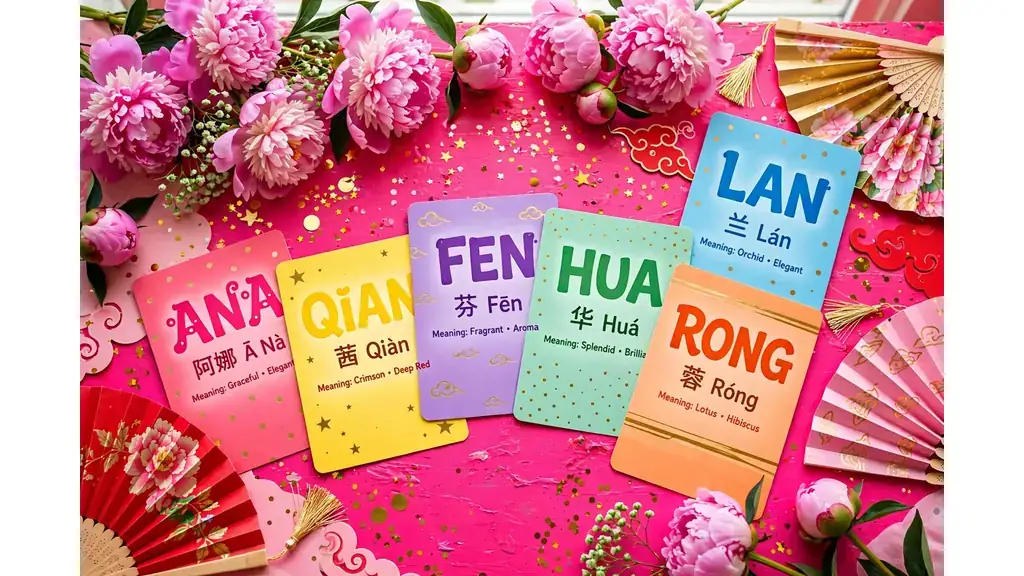
| Name (Pinyin) | Meaning | Notes |
|---|---|---|
| Mei (měi) | Beautiful | The classic feminine name; one of the most recognized Chinese girl names worldwide. |
| Xiu (xiù) | Elegant, refined | Often appears in compounds like Xiuying; a timeless pick. |
| Lan (lán) | Orchid | The orchid symbolizes refinement and integrity in Chinese culture. |
| Fang (fāng) | Fragrant, virtuous | A beloved favorite across several generations. |
| Na (nà) | Graceful, elegant | Character-dependent; often used as a soft second syllable. |
| Li (lì) | Beautiful | Also written as “plum”; a top given name for decades. |
| Jing (jìng) | Crystal / Quiet | Character-dependent: 晶 (crystal) or 静 (quiet, serene). |
| Ting (tíng) | Graceful, slim | A staple of the 1980s–90s generations, still charming today. |
| Hui (huì) | Intelligent, wise | Character-dependent: 慧 (wisdom) or 惠 (kindness). |
| Ying (yīng) | Brave, flower | Also means “hero”; appears in countless name combinations. |
Chinese Girl Names With Beautiful Meanings
Flowers, the moon, and jade dominate the most poetic Chinese girl names. These picks are chosen for what they picture — a lotus rising from still water, moonlight, the glint of precious stone. For even more lovely options, browse our names for girls roundup.
| Name (Pinyin) | Meaning | Notes |
|---|---|---|
| Lian (lián) | Lotus | The lotus stands for purity rising above muddy water. |
| Hua (huā) | Flower | Character-dependent: 花 (flower) or 华 (splendid). |
| Wei (wēi) | Rose | A delicate floral name with a soft, lyrical sound. |
| Yue (yuè) | Moon | Character-dependent: 月 (moon) or 悦 (joy, delight). |
| Gui (guì) | Osmanthus | The fragrant autumn blossom prized in Chinese poetry. |
| Rong (róng) | Hibiscus | Character-dependent: 蓉 (hibiscus) or 荣 (glory). |
| Yu (yù) | Jade | Character-dependent: 玉 (jade) or 雨 (rain). |
| Yao (yáo) | Precious jade | An ornamental gemstone name with a luminous sound. |
| Ling (líng) | Tinkling of jade | Evokes the gentle sound of jade pendants. |
| Cui (cuì) | Kingfisher green | The vivid green of jade; a striking, unusual name. |
Unique & Rare Chinese Girl Names
If you want a name that stands out, these rarer picks offer beauty without the crowd. They are real, established names — just less common than the classics. Pair them with ideas from our unique girl names with meanings for more distinctive inspiration.
| Name (Pinyin) | Meaning | Notes |
|---|---|---|
| Xinyi (xīnyí) | Joyful, righteous | Character-dependent; a modern two-syllable favorite. |
| Wan’er (wǎn’ér) | Gentle, graceful | Soft and literary; the “-er” ending is affectionate. |
| Xia (xiá) | Rosy clouds | Poetic and uncommon in everyday given names. |
| Pei (pèi) | To admire | The character 佩 also means a worn jade pendant. |
| Fei (fēi) | Fragrant / Falling snow | Character-dependent: 菲 (fragrant) or 霏 (falling snow). |
| Bi (bì) | Green jade | The character 碧 paints deep green-blue jade. |
| Dai (dài) | Dark eyebrow pigment | Literary and romantic; 黛 is a classic poetic image. |
| Lei (lěi) | Bud | The character 蕾 means a flower not yet bloomed. |
| Xuan (xuān) | Daylily | The daylily 萱 symbolizes filial devotion. |
| Lu (lù) | Dew | Fresh and simple; the character is 露. |
Nature-Inspired Chinese Girl Names
The seasons, the sky, and the landscape give Chinese naming some of its most vivid imagery. These nature names feel fresh and grounded — a snowy morning, spring’s first warmth, a rainbow after rain.
| Name (Pinyin) | Meaning | Notes |
|---|---|---|
| Xue (xuě) | Snow | Crisp and pure; a winter-born favorite. |
| Chun (chūn) | Spring | New beginnings and warmth in one syllable. |
| Qiu (qiū) | Autumn | Golden-season imagery; calm and mellow. |
| Xia (xià) | Summer | Note the tone differs from Xia (xiá, “rosy clouds”). |
| Chen (chén) | Morning | The character 晨 means the early morning hours. |
| Feng (fēng) | Phoenix / Maple | Character-dependent: 凤 (phoenix) or 枫 (maple). |
| Hong (hóng) | Rainbow / Red | Character-dependent: 虹 (rainbow) or 红 (red). |
| Jin (jǐn) | Brocade | The character 锦 means rich, patterned silk. |
| Tao (táo) | Peach | The peach 桃 symbolizes longevity and spring. |
| Cai (cǎi) | Colorful | Bright and lively; the character is 彩. |
Timeless Virtue Names
Many Chinese girl names carry a wish — for kindness, peace, wisdom, or grace. These virtue names never go out of style, and they sit comfortably beside similar traditions like our Japanese girl names and Korean girl names collections.
| Name (Pinyin) | Meaning | Notes |
|---|---|---|
| Shu (shū) | Kind and gentle | The character 淑 is the classic word for ladylike virtue. |
| Ya (yǎ) | Elegant | Simple, refined; the character is 雅. |
| Wen (wén) | Cultured | The character 文 carries literary, scholarly grace. |
| Ning (níng) | Peaceful | Calm and steady; the character is 宁. |
| An (ān) | Peace | One of the simplest and most reassuring names. |
| Zhen (zhēn) | Precious | The character 珍 means a treasured thing. |
| Qing (qīng) | Clear, pure | Character-dependent: 清 (clear), 青 (blue-green), 晴 (sunny). |
| Xin (xīn) | Joyful | Character-dependent: 欣 (joyful) or 心 (heart). |
| Ping (píng) | Peaceful | Character-dependent: 平 (peaceful) or 萍 (duckweed). |
| Rui (ruǐ) | Flower bud / Wise | Character-dependent: 蕊 (bud) or 睿 (wise, far-sighted). |
How Chinese Naming Works
Chinese naming follows a few beautiful conventions that are worth knowing before you choose. The family name (surname) comes first, followed by the given name — so a girl named Mei in the Wang family is written Wang Mei. The given name itself is usually one or two syllables, and parents choose the characters with great care, since the characters fix the meaning, as explained on Wikipedia’s overview of Chinese given names.
Many families use a generational name: siblings and cousins of the same generation share one character, which makes the family bond visible in every name. Tones matter enormously — mā, má, mǎ, and mà are four different words — so pinyin without tone marks is only an approximation. And because one pinyin syllable can map to dozens of characters, two girls both called “Xin” can have completely different names on paper. That is why, throughout this guide, meanings are tied to the most common feminine characters and flagged as character-dependent where the pinyin alone cannot decide.
Tips for Choosing a Chinese Girl Name
- Choose the characters, not just the sound. The pinyin is the pronunciation; the characters are the name. Always settle the meaning in writing before you commit.
- Check the tones. The same syllable in a different tone is a different word — listen to each tone and make sure the one you want is the one people will say.
- Watch for unlucky homophones. A beautiful name can share its sound with an unfortunate word. Say the full name aloud and check with a native speaker, since character choice changes everything.
- Keep the stroke balance pleasing. Many parents consider how the characters look together — balanced, elegant strokes are traditionally valued. Behind the Name is a solid starting point for verifying a name’s documented roots.
- Think about the full name. The given name sits after the family name, so read the whole thing — Wang Mei, Li Xue — and listen for rhythm and flow.
- Respect the tradition. If you are choosing a Chinese name for a child outside Chinese culture, learn the meaning, the tones, and the characters — a name deserves to be used with understanding.
Frequently Asked Questions
Is the family name really written first in Chinese names?
Yes. In Chinese convention the surname comes first, then the given name — for example, Li Mei means Mei of the Li family. In Western contexts the order is sometimes flipped, but within Chinese naming the family name always leads.
Why do Chinese name meanings say “character-dependent”?
Because pinyin romanization is ambiguous: many different characters share the same spelling and even the same tone, each with its own meaning. Hui could be 慧 (wisdom) or 惠 (kindness), and only the chosen characters decide which. Any honest name list has to say so.
Are Chinese girl names usually one or two syllables?
The given name is usually one or two syllables; two-syllable given names (like Xinyi) are increasingly popular. The family name is almost always a single syllable, so most full names are two or three syllables long.
What is a generational name?
A generational name is a character shared by all children of the same generation in a family — siblings and cousins alike carry it. It marks the family bond and the birth order at a glance, and it is one of the most distinctive features of Chinese naming.
Can I use a Chinese name if I am not Chinese?
You can, but do it thoughtfully: learn the correct characters, tones, and meaning, and check the full name with a native speaker for unlucky homophones. A name used with real understanding is a sign of respect; a name picked for sound alone can cause embarrassment.
Where can I find more name ideas?
Browse our full name collections for hundreds more verified names with meanings — from neighboring traditions to baby-name favorites.
Conclusion
From Mei (“beautiful”) to Lan (“orchid”) to Xue (“snow”), Chinese girl names pack entire poems into a syllable or two. The 50 names above cover the beloved classics, the most beautiful meanings, rare hidden gems, nature imagery, and timeless virtues — each with pinyin and an honest note on where the meaning comes from. Remember the golden rule: the characters are the name, so always confirm them before you fall in love with a sound. Pick the name whose meaning you would be proud to explain, check its tones, and you will have a name that carries beauty in every stroke.