The Difference Between Murder and Homicide in Australia | NSW Criminal Law Guide 2026
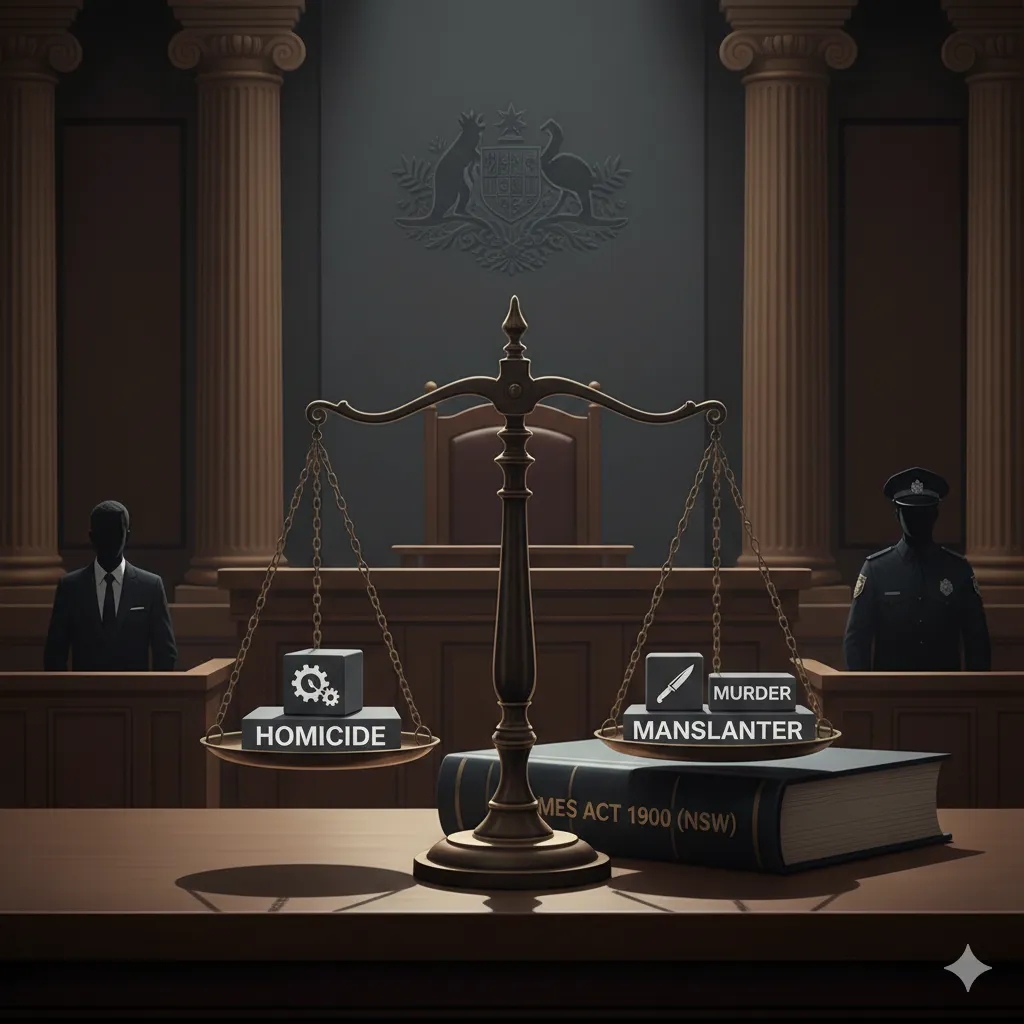
Understanding the difference between murder, homicide, and manslaughter is essential within the Australian legal system—especially in New South Wales (NSW), where criminal offences relating to unlawful death carry some of the harshest penalties available. These terms are often misused interchangeably in everyday conversation, but in law, they carry very distinct meanings, legal criteria, and sentencing outcomes.
This comprehensive guide explains the definitions under NSW law, key legislative sections, intent requirements, examples, penalties, court processes, and what happens if you are charged with murder or a homicide-related offence.
Homicide vs Murder — Is There a Difference?
Yes. While all murders are homicides, not all homicides are murders.
The structure is simple:
- Homicide = any killing of one person by another
- Murder = a specific type of unlawful homicide involving intent or reckless indifference to human life
- Manslaughter = an unlawful killing without intent to kill
In short:
- Homicide is the category
- Murder and manslaughter are the subcategories
This distinction is crucial because the mental element (mens rea) is what separates one offence from another.
Definition of Homicide
In Australia, homicide is an umbrella term that refers to any death caused by the act—or omission—of another person. This includes lawful and unlawful killings.
Unlawful Homicide
Unlawful killings include:
- Murder
- Voluntary manslaughter
- Involuntary manslaughter
- Vehicular manslaughter
- Criminally negligent homicide
Lawful Homicide
Lawful killings occur when a person’s actions are justified under the law.
Examples include:
- Self-defence
- Defence of others
- Justifiable force under police duties
For a homicide to be criminal, it must fail to meet legal justification or excuse.
Examples of Homicide in Australia
Here are real-world scenarios demonstrating different types of homicide:
Unlawful Homicide Example
A person strikes someone with the intent to cause serious harm. The victim dies.
→ This could be murder or manslaughter, depending on intent.
Lawful Homicide Example
A homeowner uses proportionate force to defend their life during a violent home invasion, resulting in the offender’s death.
→ Usually self-defence, meaning no criminal liability.
Reckless Homicide Example
A driver speeds through a busy pedestrian zone and kills someone.
→ Could be manslaughter based on criminal negligence.
These distinctions matter greatly in court because they determine charges, penalties, and possible defences.
Definition of Murder (NSW Law)
Under Section 18 of the Crimes Act 1900 (NSW), murder occurs when a person causes the death of another:
- With intent to kill, OR
- With intent to inflict grievous bodily harm, OR
- With reckless indifference to human life, OR
- During the commission of a serious criminal offence (known as constructive murder or felony murder)
Key Elements the Prosecution Must Prove
To convict someone of murder, the prosecution must prove:
- Act or omission by the accused
- Causation — the act caused the death
- Mental state, meaning one of the following:
- Intention to kill
- Intention to cause really serious injury
- Reckless indifference to human life (foreseeing the probability of death)
- Participation in a serious offence resulting in death (constructive murder)
If the act does not meet these mental elements, the offence may be downgraded to manslaughter.
Definition of Manslaughter
Manslaughter applies when a death results from unlawful actions but without intent to kill.
There are three main types:
Voluntary Manslaughter
Intentional killing in circumstances that reduce culpability, such as:
- Provocation
- Substantial impairment by mental health conditions
Involuntary Manslaughter
Killing without intent due to:
- Criminal negligence, OR
- Unlawful and dangerous act
Vehicular Manslaughter
Deaths caused by dangerous driving, reckless driving, or intoxication.
Key Differences Between Murder and Manslaughter
| Legal Concept | Murder | Manslaughter |
|---|---|---|
| Intent | Required | Not required |
| Mens Rea | Intent to kill, intent to cause GBH, or reckless indifference | Negligence, recklessness, unlawful act |
| Maximum Penalty | Life imprisonment | 25 years |
| Severity | Highest category of homicide | Lower than murder |
| Examples | Stabbing, shooting, planned killing | Negligent driving causing death |
Intent is the most important legal distinction.
Potential Penalties for Homicide vs Murder in NSW
Homicide offences carry some of the most severe punishments in Australia because they involve the loss of human life.
Penalties for Murder (NSW)
Under Section 19A of the Crimes Act 1900 (NSW):
- Maximum penalty: Life imprisonment
- Non-parole period:
- Standard = 20 years
- Aggravated cases = 25 years (e.g., child victim, killing a police officer)
A life sentence in NSW means imprisonment for the remainder of the offender’s natural life.
Penalties for Manslaughter
The maximum penalty under NSW law:
- 25 years imprisonment
Manslaughter sentences vary significantly based on circumstances, level of negligence, and aggravating or mitigating factors.
Will I Go to Court for Homicide or Murder Charges?
Yes.
Every homicide-related charge absolutely requires a court appearance because of its seriousness.
Where the Case Begins
- All homicide matters start in the Local Court for procedural mention.
Where the Case Proceeds
- Homicide and murder are then committed to the Supreme Court of New South Wales.
How the Case Is Finalised
- Finalised by jury trial (if you plead not guilty)
- Or by sentencing hearing (if you plead guilty)
Because of the stakes, legal representation is essential.
What Happens if You Are Charged With Homicide in NSW?
If charged with homicide, the likely process is:
Arrest and Charging
Police formally charge you with murder, manslaughter, or another homicide category.
First Mention in Local Court
The magistrate reads the charge and deals with bail (if applicable).
Committal Hearing
The matter is transferred (“committed”) to the Supreme Court.
Supreme Court Trial or Sentencing
- Not guilty plea → Jury trial
- Guilty plea → Sentencing hearing
Throughout the process, the prosecution must prove every legal element beyond reasonable doubt.
What Happens if You Are Charged With Murder?
If you plead not guilty, the prosecution must prove that you:
- Caused the death, and
- Intended to kill or cause serious harm, or
- Acted with reckless indifference to human life
This is a high threshold, but if proven, the penalties are extremely severe.
If You Plead Guilty
You may face:
- Life imprisonment, OR
- A fixed term + non-parole period (usually 20–25 years)
The exact sentence depends on aggravating and mitigating circumstances.
Is There a Difference Between Homicide, Murder, and Manslaughter?
Yes — and the differences are crucial.
- Homicide = any killing of another person
- Murder = unlawful killing with intent or reckless indifference
- Manslaughter = unlawful killing without intent
The legal outcomes depend heavily on evidence of intent, causation, and mental state.
Examples of Murder vs Manslaughter for Clarity
Example of Murder
A person stabs someone knowing it could kill them.
→ Intent is clear → Murder.
Example of Manslaughter
A drunk driver runs a red light and kills a pedestrian.
→ No intent → Manslaughter based on criminal negligence.
Example of Reckless Indifference (Still Murder)
A person fires a gun into a crowded room without aiming at anyone.
→ They foresaw that death was probable → Murder.
Can You Be Charged by Both NSW and the Federal Government?
Yes.
Despite the traditional belief that double jeopardy should prevent dual prosecutions, Australian law allows both federal and state authorities to prosecute if each jurisdiction has a valid legal interest.
This principle was highlighted after the Rodney King proceedings, which clarified that dual prosecutions can occur.
Key Takeaways
- Homicide is a broad category that includes all killings
- Murder requires intent or reckless indifference
- Manslaughter applies when there is no intent
- Murder carries life imprisonment in NSW
- Manslaughter can carry up to 25 years
- All homicide charges go to the NSW Supreme Court
- Intent, causation, and mental state determine the outcome
Need the Best Criminal Offences Lawyer in NSW?
Homicide, murder, and manslaughter charges can change your life forever. If you or someone you know is facing such charges, you must seek immediate legal advice.
An experienced NSW criminal defence lawyer can:
- Challenge prosecution evidence
- Argue self-defence or lack of intent
- Negotiate charge reductions
- Represent you in the Supreme Court
- Protect your rights from beginning to end
Your freedom and future depend on expert representation.